Problem
Most productivity tools store tasks; very few help you decide. I kept capturing thoughts, goals, and half-decisions across apps, and none of them helped me move from a messy input to a plan I would actually commit to.
Six agents — an orchestrator plus five specialists — a four-layer memory, and 1,600+ backend tests: a decision coach that remembers who you are.
Most productivity tools store tasks; very few help you decide. DecisionEase helps you move from a messy input to a plan you would actually commit to, backed by a memory that reflects who you are.
It is a web app you can install like a native app on your phone or desktop. The repository is private; code is available on request.
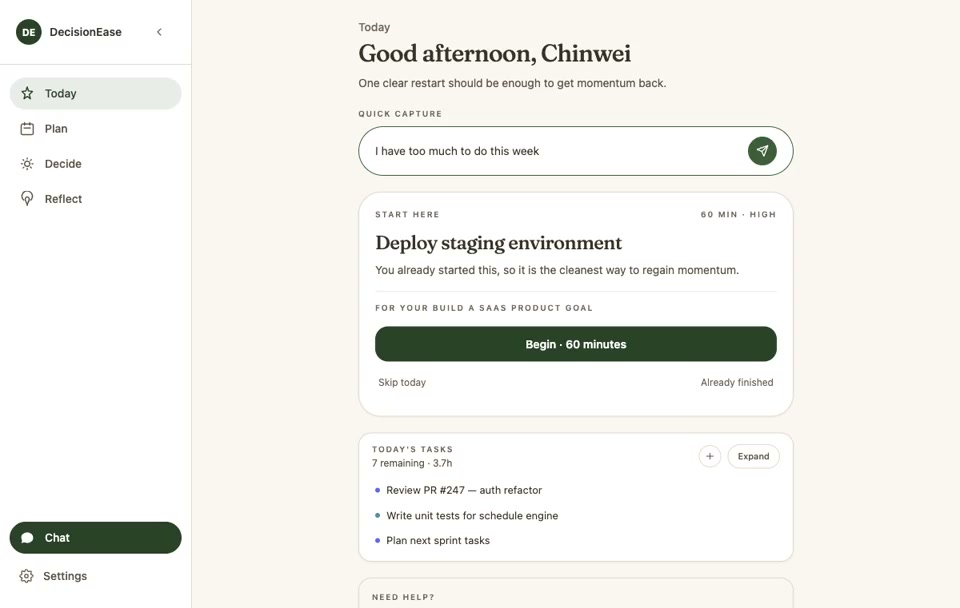
These captures come from a scripted end-to-end simulation of one full day of use — 70 logged steps — run against the live build on 2026-05-26. The script drives the real interface: it adds tasks, runs a focus timer, plans timeboxes, opens a decision, sets commitments, and reflects on the day.
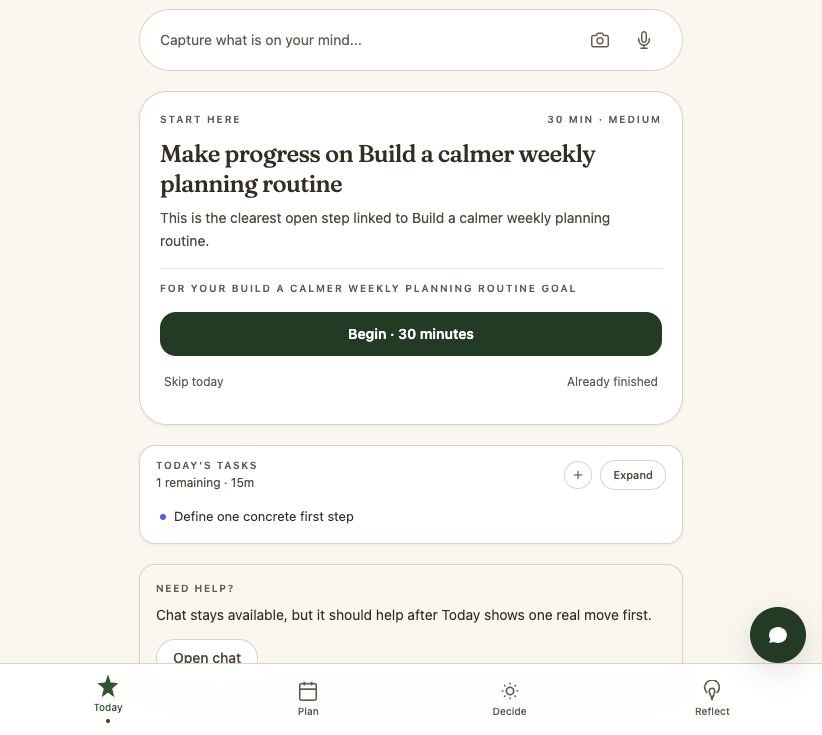
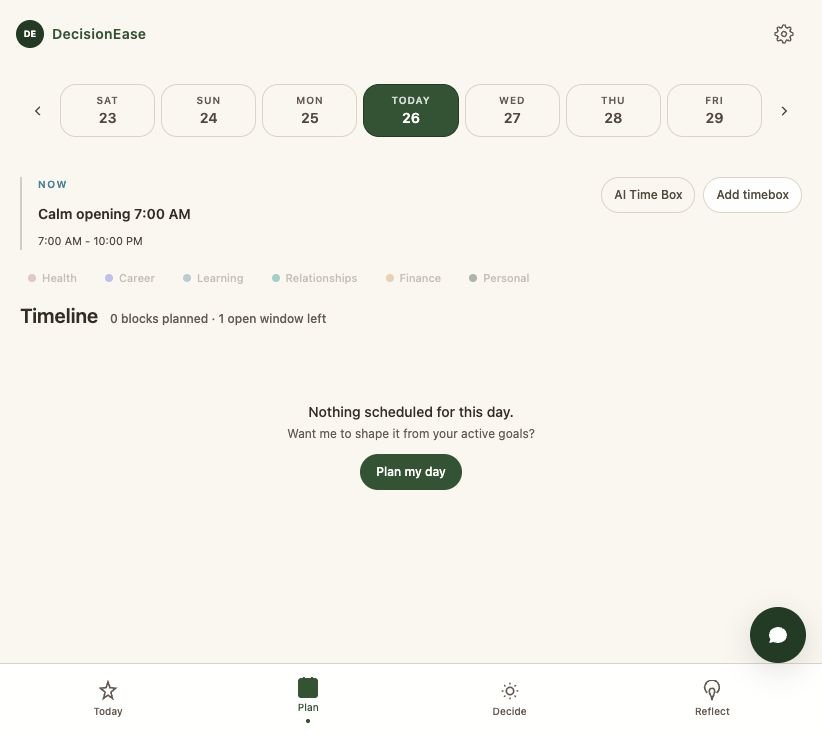
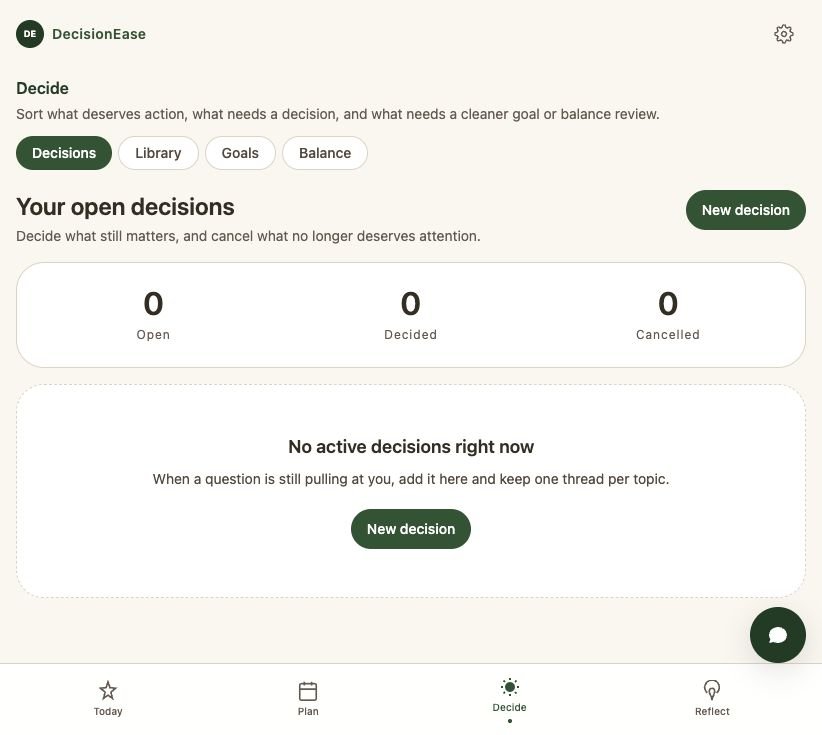
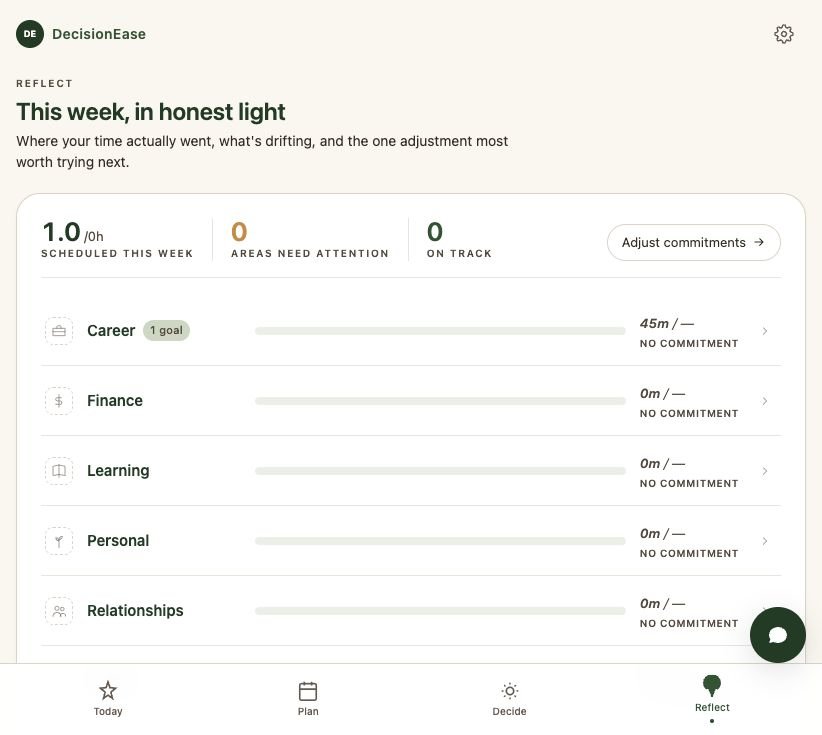
1. Open Add task modal
2. Type task: Review priorities for the day
3. Set task estimate to 20 minutes
4. Choose Career life area for task
5. Toggle save as shortcut
6. Save new task
7. Open Add task modal for second task
8. Type task: Send Sam roadmap update
9. Set roadmap email estimate to 15 minutes
10. Choose Career area for roadmap email
11. Save roadmap email task
12. Open Add task modal for third task
… 58 more steps through plan, decide, balance, reflect, and chat
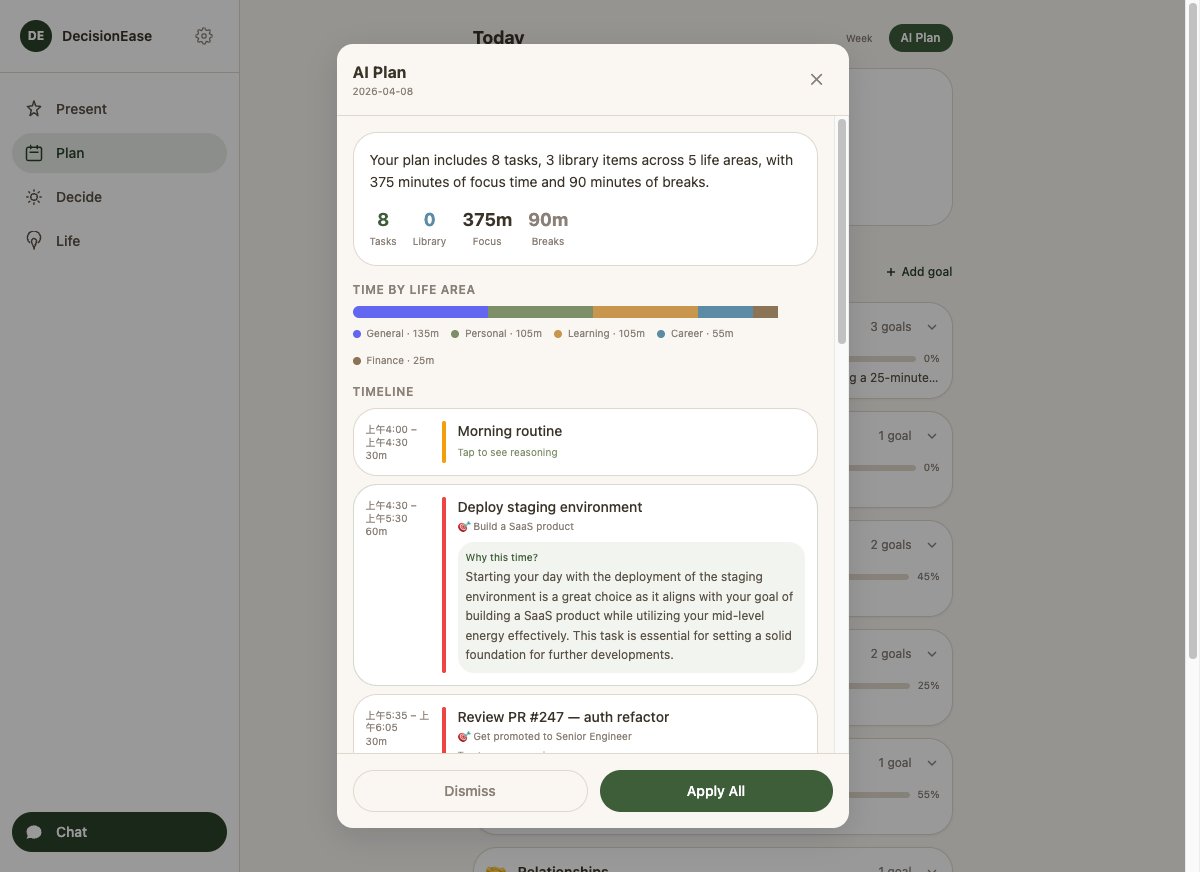
DecisionEase is a web app you can install like a native app on your phone or desktop. When you capture a thought, it runs through six agents coordinated around a single workflow — an orchestrator plus five specialists.
Most productivity tools store tasks; very few help you decide. I kept capturing thoughts, goals, and half-decisions across apps, and none of them helped me move from a messy input to a plan I would actually commit to.
A single chatbot with one giant prompt forgets your context, drifts in tone, and gets expensive fast. I wanted to find out whether a team of smaller, disciplined AI components with real memory could do better.
The Orchestrator routes each captured thought to one of the five specialists — a Coach, a Planner, an Analyst, a Curator, and a Companion — each with a fixed token budget so every turn has a known cost. Agents talk to each other under a hard five-second timeout with a cached-data fallback, so one slow specialist never stalls your conversation. Agents reach data through a safe tool-use layer (MCP): seven internal tools plus connectors for Google Calendar, Notion, and YouTube. The frontend is a Next.js 14 progressive web app; the backend is FastAPI covered by 1,600+ automated tests.
What makes the advice personal is a four-layer memory:
One capture moves through the whole system: the Orchestrator routes it, a specialist answers it, tools ground it in your real data, and the four-layer memory keeps the advice personal.
The lessons from this build are about discipline, not model choice: budgets, lifecycles, fallbacks, and written rules did more for the product than any prompt.
Giving each agent a strict budget and a narrow role produced more consistent behavior than one powerful generalist prompt.
I had to build explicit promotion and decay rules, or old entries polluted retrieval.
The timeout-plus-fallback path mattered more to the user experience than any prompt improvement.
As a solo builder, writing my architectural rules down as hard invariants — one feature in progress at a time, one embedding standard, fixed agent budgets — kept the project coherent across many working sessions.
The product is verified end to end by the backend test suite and four Playwright browser-test configurations.
DecisionEase is live and installable at decisionease.vercel.app, verified end to end by the backend test suite and four Playwright browser-test configurations. The repository is private; code is available on request.