Practical AI product judgment
I can turn a vague workflow into a concrete product direction: who uses it, what problem it solves, what data it needs, and what result should be verifiable.
8 specialist agents, 28 MCP tools, RAG, and 1,909 tests — an enterprise-style HR platform built as a production-readiness study.
I build practical AI products that can move toward production work: testable systems, verifiable results, and workflow logic that survives more than a demo.
The HR Intelligence Platform is a personal project for learning multi-agent systems, RAG, and AI-assisted product development. I use AI tools, but I do not let them own the product judgment. The dashboard link below hits the live Cloud Run deployment (HTTP 200, checked July 2026).
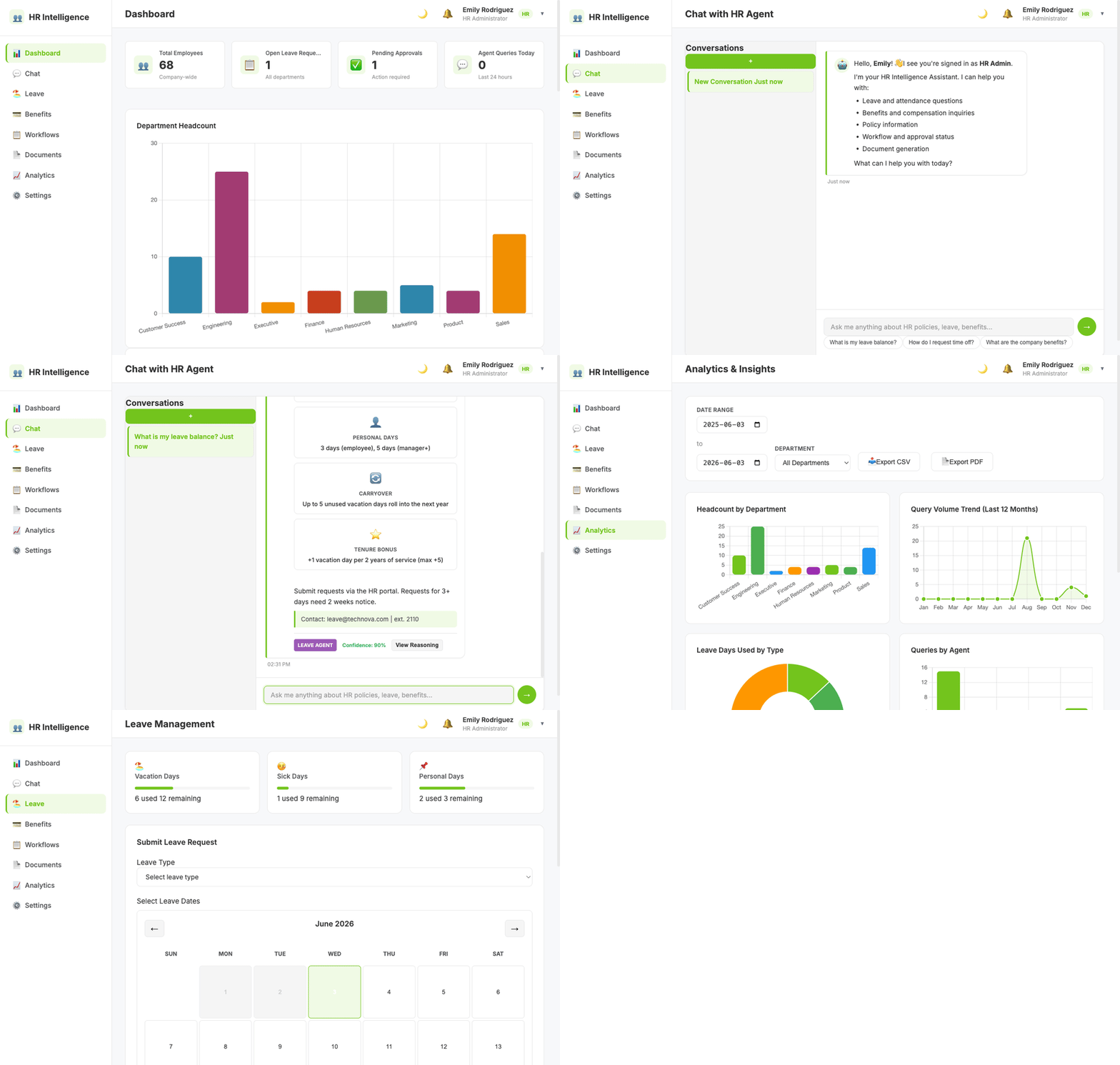
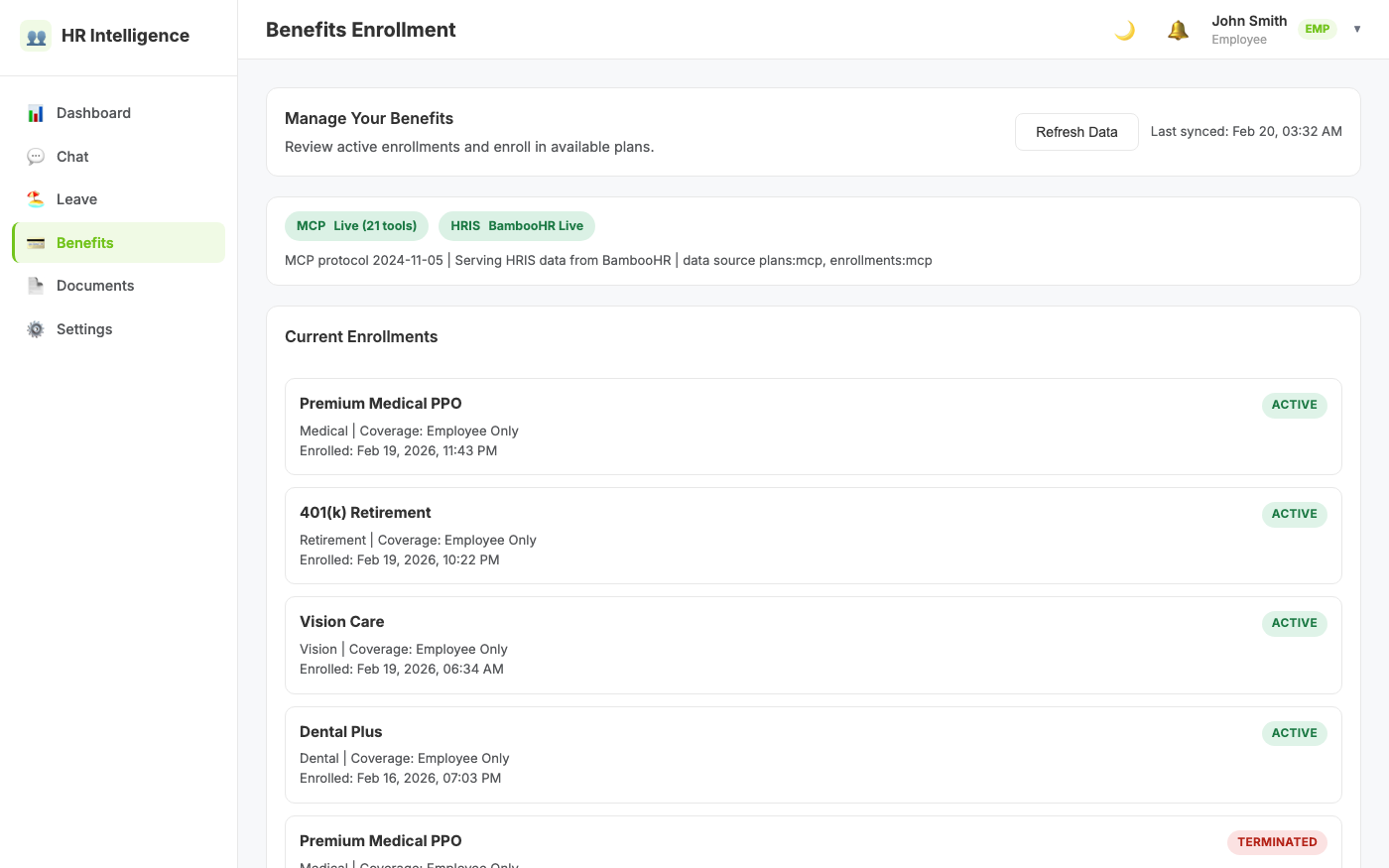
The proof comes straight from the repository and the running system: a committed demo capture, working UI screenshots, and raw API responses. The Cloud Run deployment is live — the dashboard responds with HTTP 200 (last checked July 2026).
{
  "data": {
    "active_provider": "local_db",
    "connector_class": "LocalDBConnector",
    "fallback_reason": "bamboohr connector failed health check.",
    "health_check_requested": true,
    "healthy": true,
    "requested_provider": "bamboohr",
    "using_fallback": true
  },
  "error": null,
  "success": true,
  "timestamp": "2026-02-20T07:47:23.927788"
}
This project is built for the work AI consultants, AI product engineers, and founding engineers actually do: not only building features, but turning messy workflows into reliable product systems.
I can turn a vague workflow into a concrete product direction: who uses it, what problem it solves, what data it needs, and what result should be verifiable.
I use Codex, Claude, and browser agents to move faster, but I keep ownership of the plan, product logic, validation, and final judgment.
I think beyond the demo: integrations, sandbox data, UAT, agent tests, browser tests, deployment, observability, security, and maintenance.
I learned across agent orchestration, RAG, MCP, GCP, CI/CD, dashboard workflows, and testing while keeping the project pointed toward a usable product outcome.
HR teams answer repetitive policy, benefits, and employee workflow questions. A useful AI product should centralize company knowledge, support 24/7 inquiry, reduce admin time, and still respect workflow logic, integrations, and private data.
Independent AI/full-stack builder. I shaped the product idea, chose the RAG approach, wrote prompts, directed the AI coding workflow, deployed the system, and judged whether the result was ready enough to showcase.
A supervisor-routed LangGraph system, Flask API, FastMCP server, ChromaDB knowledge layer, PII masking, RBAC, BambooHR sandbox data ingestion, observability, and browser-tested dashboard flows.
It shows how I turn uncertainty into a product path: make the idea concrete, reduce HR inquiry time, test the logic, and move the work toward a production-like system with verifiable results.
I checked the repository structure instead of relying only on the project claim. Everything below can be inspected directly by a recruiter, collaborator, or technical reviewer.
Source folders include specialist agents, router logic, MCP servers, a FastMCP tool registry, BambooHR, Workday, and custom HRIS connectors.
The repo includes HR policy knowledge bases, ChromaDB/RAG services, PII stripping, JWT auth, RBAC, rate limiting, request logging, sanitization, and security headers.
Architecture docs, API reference, demo summary, verification report, development notes, and testing reports give a review trail for the system design.
The repo contains unit tests, integration tests, E2E chatbot tests, Playwright browser tests, and manual screenshots for MCP, HRIS, and benefits flows.
This project became a way to learn the system behind the system: how a platform works, how cloud deployment works, and how to use AI coding tools without letting them decide the product for me.
As a new grad, the hardest part was digesting a large amount of information quickly and still making practical decisions. I had to build while not fully knowing whether the product, workflow, or validation path would work.
I used Codex, Claude, and Playwright to inspect, refine, and test the product. The learning was not "AI writes code for me"; it was how to give AI a concrete plan, review its output, and keep the system aligned with the product goal.
AI can create a polished demo quickly, but that does not mean the product works under real workflows or data. Adding sandbox BambooHR data, tests, and browser checks made the showcase more believable.
The project pushed me to think beyond features: service integration, UAT, logic flow, observability, CI/CD, security, and the maintenance work that makes an AI product usable after the first demo.
For a non-technical reader, the platform helps teams manage employee information, company knowledge, benefits, and HR inquiries through a 24/7 chatbot. For technical readers, the value is in routing, retrieval, tools, testing, and traces.
I learned that AI-assisted tests can still miss important logic. The stronger approach was a test pyramid: unit, integration, system, browser, agent-flow, and human review.
The 1,909-test claim is useful, but the more honest signal is that testing exposed problems too. One 60-query E2E report surfaced router and confidence issues, which made the project more credible as a learning artifact.
Finding - Routing, ownership, handoffs, and fallback behavior need to be explicit before the system grows.
Study Note - AI-assisted tests can pass too easily, so human review and scenario coverage still matter.
Technical Deep Dive - Tool calls become product behavior when they touch HR data, service integrations, and user tasks.
Finding - Source-backed answers made the chatbot less like a demo and more like a system with evidence.
Study Note - A demo shows possibility; tests, sandbox data, and browser checks show what can survive usage.
Technical Deep Dive - MCP made integrations easier to inspect, reuse, and reason about as agent-facing interfaces.
Finding - BambooHR-style employee data reminded me that privacy has to be part of the workflow design early.
Study Note - A good router is a product judgment call: who should answer, what data is needed, and when to stop.